Certified Primary Stroke Center
The specially trained stroke team and emergency personnel at Texoma Medical Center (TMC) are ready 24 hours a day to quickly respond to stroke emergencies and begin treatment. We are the first hospital in the Texoma area to have a neurointerventional suite for advanced diagnosis and treatment of stroke.
 Stroke risk assessment
This health assessment can help you learn if you're at risk for a stroke.
National recognition for advanced stroke care
TMC is certified as a Primary Stroke Center by The Joint Commission, a recognition considered to be the gold standard for stroke patient care. We have also been designated as a Level II Primary Stroke Facility by the Texas Department of Health Services.
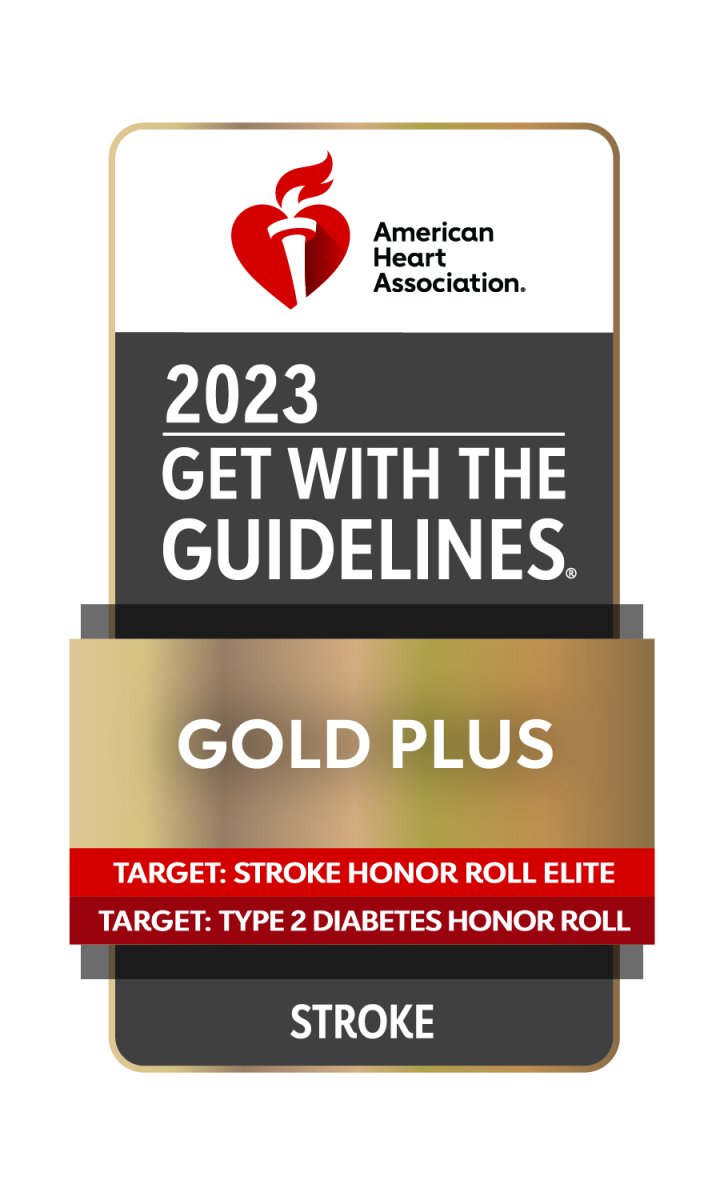 For 2023, we are proud to have earned the American Heart Association®/American Stroke Association® Get With The Guidelines®- Stroke GOLD PLUS with Honor Roll Elite Plus designation which is the highest level of recognition a stroke facility can receive for tPA performance and stroke metrics. We have also earned the Target Stroke: Type 2 Diabetes Honor Roll Achievement Award.
 Texoma Medical Center was also named a High Performing Hospital for Stroke by U.S. News & World Report. This is in recognition of care that was significantly better than the national average, as measured by factors such as patient outcomes.
Get a physician referral
For a non-emergency referral to a physician at Texoma Medical Center who can help assess your risk for stroke, call our free physician referral service at 903‑416‑3627.
Stroke explained
A stroke occurs when blood flow to the brain is blocked or stopped. Within a few minutes of a stroke, brain cells begin to die. According to the American Heart Association, stroke is the third leading cause of death in the US and can lead to long-term disability. Problems that can arise include weakness in an arm or leg after a small stroke to paralysis and loss of speech in larger strokes. This is why it's so important to get medical attention as quickly as possible.
Quiz: How much do you know about strokes?
Test your knowledge about strokes, including risk factors, symptoms and statistics.
Stroke types and symptoms
There are two kinds of stroke: ischemic and hemorrhagic. In ischemic stroke, the most common type, a blood clot blocks a blood vessel in the brain. In hemorrhagic stroke, a blood vessel breaks and bleeds into the brain. Symptoms of possible stroke include:
- Numbness or weakness of the face, arm or leg—especially on one side of the body
- Difficulty with speaking or understanding speech
- Trouble seeing in one or both eyes
- Trouble walking, dizziness, loss of balance or coordination
- Severe headache with no known cause
2023 TMC stroke outcomes
- Overall Hemorrhagic Transformation: IV Thrombolytic and Mechanical Endovascular Therapy: 3.8%
- Stroke within 24 hours of Diagnostic Cerebral Angiogram: 1.1%
Neurointerventional Suite for diagnosis and treatment
Our neurointerventional suite offers biplane angiography, an advanced, minimally invasive technology used to diagnose and treat stroke and other neurological conditions. TMC is the first hospital in the Texoma area to provide this service.
This minimally invasive procedure may offer patients less risk of bleeding and infection as well as a faster recovery compared to traditional brain surgery. The biplane system has two rotating cameras that recreate detailed 3D views of the blood vessels leading to the brain and within the brain. The system is capable of producing images simultaneously from two regions of a patient’s head, from front to back and side to side, decreasing the amount of time it takes to complete a neurological angiogram.
Patient story: Lisa Walker
“They were so good and immediately took me in and started working on me. The ER doctor, all of them were super,” Walker says.
Transcarotid artery revascularization (TCAR)
Transcarotid Artery Revascularization (TCAR) is a minimally invasive procedure that can help minimize that risk of a stroke occurring during surgery on the carotid artery by keeping potential stroke-causing fragments away from the brain.
BE FAST
If you or someone you're with has any of these symptoms, call 9-1-1 or get yourself or them to a hospital immediately. Staff in the emergency department will administer acute stroke medications to try to stop a stroke while it is happening. Ischemic stroke, the most common type of stroke, is treated with the 'clot-busting' drug known as tPA. To be most effective, IV thrombolytics must be given within the first hour of stroke symptom onset.
Use the acronym BE FAST to quickly identify possible strokes:
Is there a loss of balance or coordination?
Is there blurred or double vision or a sudden loss of vision?
Smile. Does one side of the face droop? Can you see the same number of teeth on each side of the face?
Hold up both arms for 10 seconds. Does one drift downward?
Repeat a simple sentence. Is the speech slurred or strange? Can you understand the person?
If these signs are present, every second counts. Call 9-1-1 immediately.
Preventing stroke
The best way to keep your brain healthy is to avoid a stroke in the first place. The best ways to prevent stroke are to do the following:
- Keep your blood pressure controlled through lifestyle changes and/or medications
- Don't smoke or stop smoking
- Take steps to manage your cholesterol
- Limit your alcohol consumption
- Exercise regularly
- Maintain a healthy weight